- The PEN Weekly
- Posts
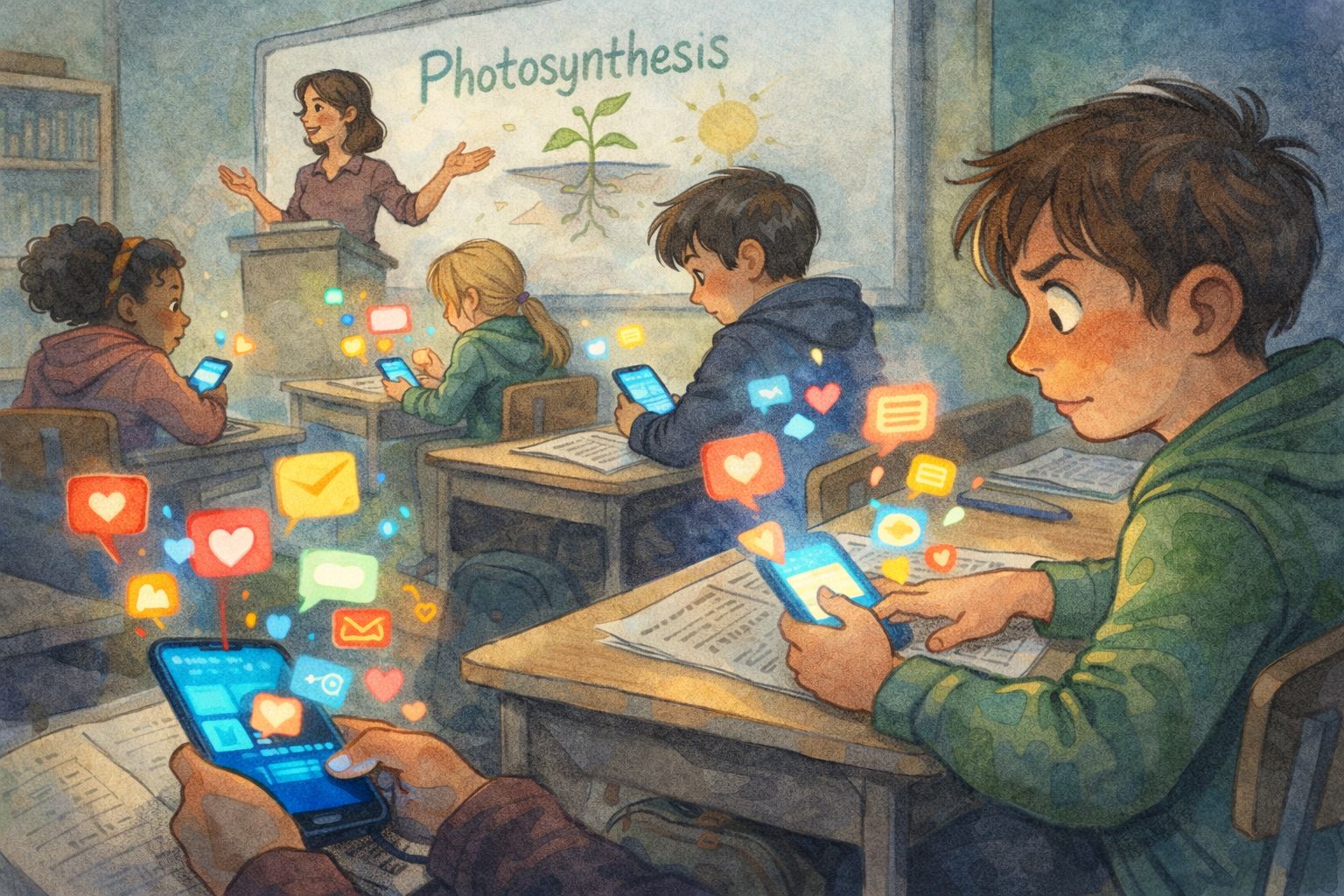
- Students aren’t just using their phones.
Students aren’t just using their phones.
They’re training their brains to check them.

Andre Violante
March 18, 2026 • Estimated Reading Time: 4 minutes

MAKING IT EASIER TO BE A BETTER TEACHER
Every teacher knows phones are everywhere in school. But a new study actually measured how often students check them during the day—and the results are hard to ignore.
This week’s Brainy Bit research reveals what constant phone checking may be doing to student attention. And this week’s Tech Tool offers a simple way to help students organize their thinking once their focus is back.
You’re about to become an even better teacher in the next 8 minutes.
🔉But first, a word from today’s sponsor for teachers who like to tinker with all things tech:
What 200K+ Engineers Read to Stay Ahead

Your GitHub stars won't save you if you're behind on tech trends.
That's why over 200K engineers read The Code to spot what's coming next.
Get curated tech news, tools, and insights twice a week
Learn about emerging trends you can leverage at work in just 5 mins a day
Become the engineer who always knows what's next
And now back to making you an even better teacher 👇️
TECH TOOL

Brainstorming Just Got Way Easier
Getting ideas onto paper is often the hardest step in learning. Students stare at a blank page, unsure where to start. Sometimes, a visual process is a better approach.
The Solution: Mindmap.so
Mindmap.so acts like a digital whiteboard built specifically for organizing thinking. Start with a central idea—say Photosynthesis—and quickly branch into subtopics like light reactions, chloroplasts, or Calvin cycle. Within seconds, an entire lesson structure appears visually.
That same structure works for students too. Essays can be mapped before writing. Projects can be broken into smaller steps. Entire units can be organized to show how topics connect.
The real classroom power comes during live teaching. Build a mind map together as students brainstorm ideas, activate prior knowledge, or unpack complex topics. At the end of a lesson, students can even create their own maps as a quick check for understanding.
Is This For YOUR Classroom?
Mindmap.so is intentionally simple. It won’t replace full collaboration tools or project management boards. But for quick brainstorming, lesson planning, or organizing student thinking, that simplicity is exactly the appeal.
Strategies That Work:
Lesson Blueprint Map: Visually outline an entire lesson so students can see how concepts connect.
Prior Knowledge Brainstorm: Start a new unit by mapping everything students already know about a topic.
Understanding Check Map: Have students build a quick mind map at the end of class to reveal gaps in understanding.
There’s no need to make an account to start, but if you want to share a link to your board with other teachers/students, then a free account is required.
Sometimes the best edtech tool is the simplest one. Mindmap.so turns scattered thoughts into visible learning.
🚀 Noteworthy News
👉️ Frustrating: Parents say school screens are taking over kids’ learning.
“Getting organized is a sign of self-respect. ”
BRAINY BIT
Students Are On Their Phones All Day (no, really)
Us teachers already knew this, but a new study actually measured it. And the numbers are… impressive.
TLDR: In a study of 79 students, researchers tracked smartphone use hour-by-hour for 14 days. Students spent about one-third of the school day on their phones. Students who checked their phones more often showed weaker cognitive control, a key skill for focus and learning.
The Study: Phone Use During School Hours
Researchers recruited 79 students aged 11–18 and tracked their phone use over two weeks. Each day, students uploaded screenshots of their phone’s screen-time report so researchers could measure exactly how many minutes phones were used each hour of the day.
The researchers then looked specifically at school hours (8 AM–3 PM).
Older students also completed a go/no-go cognitive control test, where they had to quickly respond to certain images and ignore others. This type of task measures a student’s ability to resist impulses and stay focused.
The Results:
Here’s what they found:
Students used their phones during every hour of the school day, averaging about 16–22 minutes of phone time per hour. In total, that added up to 2.22 hours of phone use during school.
The average student checked their phone about 64 times during school hours, and about 70% of that screen time was spent on social media or entertainment apps.
But that’s not even the most interesting part of this study.
What mattered most was how often students checked their phones. Students who checked their phones more frequently performed worse on the cognitive control task, meaning they had more difficulty controlling impulses and maintaining attention.
In YOUR Classroom:
The challenge may not be phone use itself - it’s the constant interruption of attention. And while this study was done on teens, adults can fall into the same category (take a peek at your own screen time for a jump scare).
Here’s how these results can impact your classroom this week:
Strategies That Work:
Create short focus sprints: Run 10–15 minute “deep focus” blocks where the entire class works phone-free before a short break.
Teach attention as a skill: Explain how constant checking trains the brain to expect interruptions.
Use phones with clear boundaries: If phones are used in a lesson, define when they start and when they go away.
Smartphones may not just distract students (and adults alike).
They may slowly train their brains to expect distraction and that may be the battle we need to fight first before outright banning devices.
WHAT DO YOU THINK?
We would LOVE to hear from you!
Reply to this email, or send us a message on Instagram! We’re here to walk with you in these crazy times!
Part of what makes The PEN Weekly community so special is the fact that our readers are teachers from around the world! We’re not going to lie, we think that’s pretty darn cool!
We’ll see you again on Monday 🍎
Do you know someone who would appreciate reading the PEN? Share this newsletter with them! Our goal is to reach as many teachers as possible, and to build a community of teachers supporting teachers.
References
Today’s newsletter adapts information from the following sources:
Tech Tool:
Mindmap.so (2026). Connect and make sense of notion pages in canvas. Retrieved from https://mindmap.so/
Brainy Bit:
Telzer, E. H., & Burnell, K. (03 2026). Smartphone Use During School Hours and Association With Cognitive Control in Youths Aged 11 to 18 Years. JAMA Network Open, 9(3), e261092–e261092. doi:10.1001/jamanetworkopen.2026.1092
Reply